
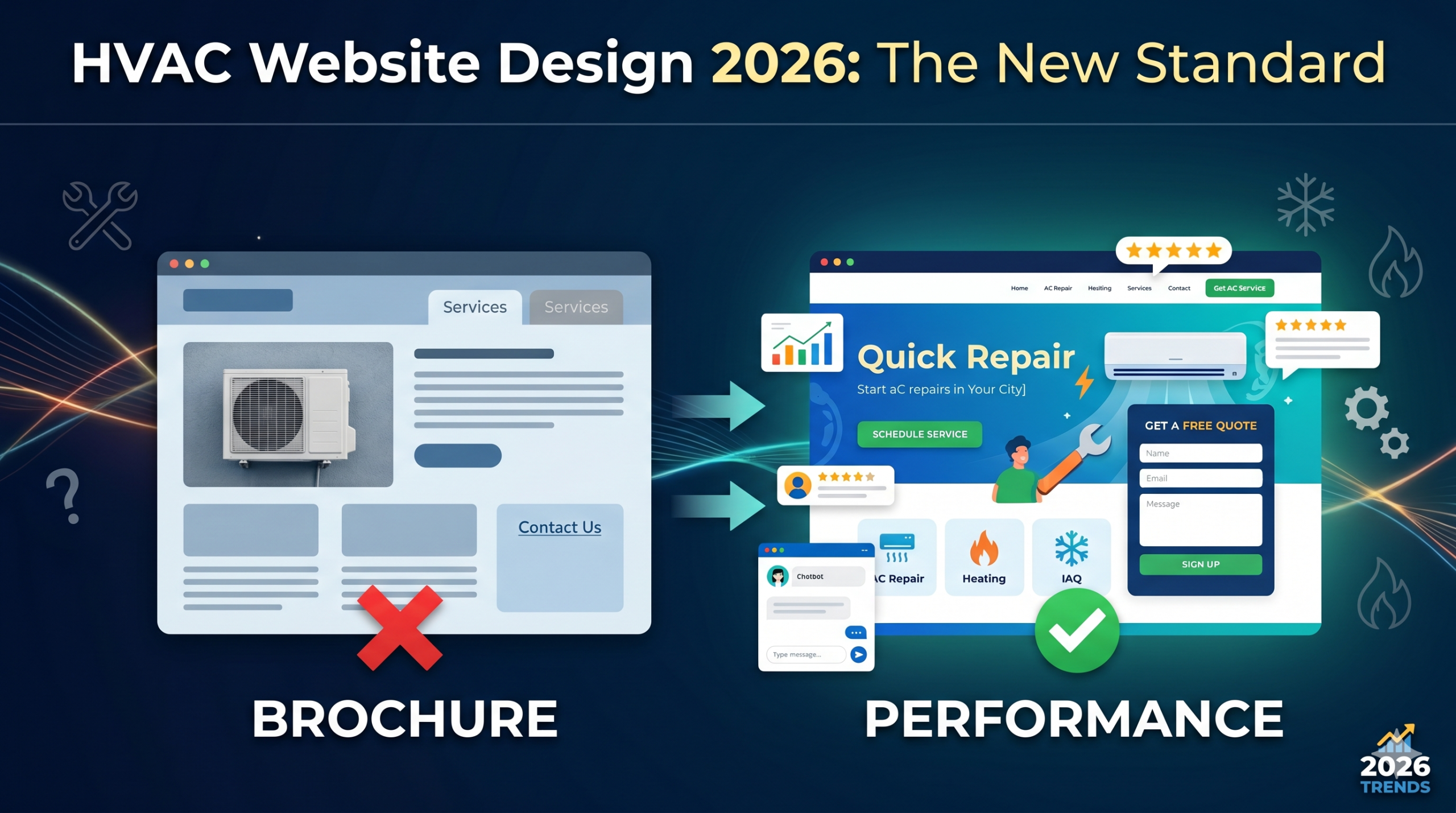
Most HVAC contractors have a website. Very few have a website that works. In this guide, we break down exactly what the best HVAC website designs do differently and how to turn yours into a consistent source of inbound calls.
Everything below is the checklist we run inside our HVAC website design service.
If you would rather know how your own site scores before you read the checklist, get your website graded in a growth audit.
Where that traffic comes from matters as much as the page it lands on. For B2B and commercial accounts, see why industrial HVAC companies are ditching Instagram for LinkedIn.
1. The Problem With Most HVAC Websites
Walk through a hundred HVAC websites and you’ll see the same issues repeated: stock photos of thermostats, an “About Us” page that says “family-owned since 1987,” a phone number buried in the footer, and a contact form nobody ever checks. These sites aren’t bad they’re just invisible. They generate no rankings, inspire no calls, and convert no visitors.
The uncomfortable truth is that a website that doesn’t generate leads is a liability, not an asset. It costs you hosting fees, domain renewals, and the ongoing opportunity cost of not capturing the homeowners who land on your site and leave without contacting you.
Benchmark: According to research cited by Sweor, it takes about 50 milliseconds for users to form an opinion about a website. For HVAC contractors, that means your design is either building or destroying trust before a visitor has read a single word.
2. What Visitors Actually Want in the First 8 Seconds
When a homeowner arrives at your website typically from a Google search, they are asking three questions in rapid succession:
- “Do you serve my area?” If they can’t tell within seconds, they leave.
- “Can I trust you?” Reviews, certifications, years in business, and real photos answer this.
- “How do I contact you?” If the phone number isn’t obvious, you’ve lost them.
Notice that none of those questions are about your company history, your fleet of trucks, or your mission statement. Homeowners with a broken AC in August don’t want your story they want to know you can show up today, fix it right, and charge a fair price. Your website’s job is to confirm all three, immediately.
3. The 10 Non-Negotiables of High-Converting HVAC Web Design
The best HVAC web design projects we’ve built share the same structural fundamentals. These aren’t design preferences — they’re conversion requirements.
HVAC Website Design Checklist
The One Element Most HVAC Sites Are Missing
Of all the elements above, the single most impactful thing most HVAC websites are missing is social proof above the fold. Homeowners decide whether to trust a contractor in seconds. If the first thing they see is a beautiful design but no proof of satisfied customers, trust remains unearned. Move your Google review count and star rating to your header. It will increase conversions immediately.
4. Mobile-First Design: Why It’s Not Optional
If your HVAC website was built before 2022 and hasn’t been touched since, there is a very high probability it is losing leads on mobile. “Mobile-responsive” — meaning the site technically scales to a phone screen — is not the same as mobile-first, which means the site was designed and optimized for mobile as the primary experience.
The practical differences are significant:
- Thumb-zone CTAs: On mobile, buttons must be in the natural thumb reach zone — center-bottom of the screen — not tucked in a top navigation bar
- Font size: Minimum 16px body text. Smaller text forces pinch-to-zoom and triggers immediate exits
- Image compression: Mobile users on 4G/5G still suffer when images are above 200KB. Uncompressed images are the #1 cause of slow HVAC websites
- Form length: Mobile contact forms should ask for name, phone, and service needed — nothing more. Every additional field reduces submission rates by ~10%
- Tap targets: All clickable elements must be minimum 44×44px to avoid frustrating mis-taps
Google’s stance: Since Google’s mobile-first indexing rollout, your site is crawled and ranked based on its mobile version. An HVAC website that performs poorly on mobile doesn’t just lose visitors — it loses rankings. Read Google’s mobile-first indexing documentation for the full technical requirements.
5. How Good Web Design Multiplies Your HVAC SEO
Design and SEO are inseparable. A beautiful HVAC website that isn’t structured for search will never rank. A technically sound site that looks unprofessional won’t convert the traffic it earns. The best HVAC website design companies build with both simultaneously.
Site Architecture for HVAC SEO
How your website is structured determines which pages Google can find, index, and rank. An SEO-optimized HVAC site structure looks like this:
- Homepage → Brand authority, service overview, trust signals
- /services/ → Hub page linking to all service subpages
- /services/ac-repair/ → Dedicated AC repair page with full SEO optimization
- /services/heating/ → Dedicated heating page
- /services/hvac-installation/ → Dedicated installation page
- /service-areas/ → Hub linking to all location pages
- /service-areas/[city]/ → Localized page per city served
- /blog/ → Content hub for topical authority
- /reviews/ → Dedicated reviews/testimonials page
- /contact/ → Optimized contact and scheduling page
This flat, logical structure ensures Google can crawl every page efficiently and that your most important pages are never more than 2–3 clicks from the homepage — a critical factor in how link equity flows through your site.
Schema Markup for HVAC Websites
Schema markup is structured data added to your HTML that helps Google understand your content and display rich snippets — star ratings, business hours, and FAQs — directly in search results. For HVAC websites, the priority schema types are:
- LocalBusiness with HVAC-specific sub-type
- Service schema on every service page
- Review / AggregateRating to display stars in SERPs
- FAQPage schema on service pages and blog posts
- BreadcrumbList for navigational clarity in search results
Google’s Rich Results Test is the free tool to verify your schema implementation. Our HVAC SEO services include full schema implementation for every new site we build or optimize.
6. HVAC Website Builder vs. Custom Design: Which Is Right for You?
| Factor | DIY Website Builder | Template (WordPress/Webflow) | Custom HVAC Web Design |
|---|---|---|---|
| Upfront cost | $0–$50/mo | $2,000–$5,000 | $5,000–$20,000+ |
| SEO capability | Limited | Good | Excellent |
| Page speed | Poor–Fair | Fair–Good | Excellent |
| Conversion optimization | DIY only | Partial | Built-in by design |
| Scalability (location pages) | Self-managed | Moderate | Unlimited |
| Ongoing support | Solo operators just starting | Varies | Agency-managed |
| Best for | Very limited | Small local HVAC companies | Growth-focused HVAC businesses |
For HVAC companies generating $500K+ annually and investing in digital marketing, a custom or semi-custom WordPress build managed by an HVAC-specialist agency consistently outperforms DIY builders on every metric that matters: load speed, SEO, and lead conversion. A professional HVAC web design agency builds the site as part of a lead generation system — not as an isolated project.
7. What the Best HVAC Website Designs Have in Common
After analyzing top-performing HVAC websites across dozens of markets, the patterns are consistent. The highest-converting HVAC web designs share these characteristics:
They Lead With Location and Service, Not Brand
The hero section doesn’t say “Welcome to ABC Heating & Cooling.” It says “Fast AC Repair in [City] — Same-Day Service Available.” The visitor’s need is confirmed before the company name is even introduced.
They Make Calling Effortless
Phone numbers are large, in the top-right corner of the desktop header, and converted to a click-to-call link on mobile. On scroll, a sticky header keeps the number visible at all times. Emergency service hours are noted clearly.
They Show, They Don’t Just Tell
The best HVAC websites use photos of real technicians in branded uniforms, real customer testimonial videos recorded on-site, and real before/after job photos. Authenticity outperforms polish in the home services space. According to BrightLocal’s Consumer Review Survey, 87% of consumers read online reviews for local businesses, and authentic visual content dramatically increases the credibility of those reviews.
They Reduce Friction at Every Step
Every unnecessary form field, confusing navigation item, and buried CTA costs leads. The best HVAC sites ruthlessly simplify the path from “I have a problem” to “I’ve contacted someone who can fix it.” That path should be no more than 2 clicks from any page.
8. How Much Does HVAC Web Design Cost in 2026?
HVAC website design pricing varies widely depending on scope, features, and provider. Here’s a realistic breakdown of what the market looks like:
| Tier | Price Range | What You Get | Best For |
|---|---|---|---|
| Freelancer / Template | $500–$2,500 | Basic WordPress theme, limited customization, no conversion strategy | Brand-new startups with minimal budget |
| Mid-tier Agency | $3,000–$8,000 | Custom design, SEO foundation, mobile-optimized, some conversion elements | Established HVAC companies investing in growth |
| HVAC Specialist Agency | $6,000–$20,000+ | Full conversion engineering, location pages, schema, CRO, integrated with SEO/PPC | Multi-location or high-revenue HVAC operators |
| Monthly Managed | $300–$800/mo | Design, hosting, updates, security, and conversion monitoring included | Companies wanting a hands-off, always-optimized site |
ROI perspective: A well-built HVAC website that generates 10 additional leads per month at a $350 average job value produces $3,500/month in new revenue. At a $6,000 build cost, payback occurs within 2 months. The question isn’t whether you can afford a proper HVAC website — it’s whether you can afford to run without one. Talk to our team about what’s realistic for your market.
Conclusion: Your Website Should Be Working as Hard as Your Technicians
Your HVAC technicians don’t show up to jobs unprepared, unbranded, or unable to close. Your website shouldn’t either. In 2026, a high-performing HVAC website is the single highest-leverage asset in your marketing stack — it amplifies the ROI of every other channel you invest in, from SEO to PPC to social media marketing.
If your site is more than 3 years old, loads slowly on mobile, or doesn’t have a clear conversion path on every page, it’s costing you leads right now. The good news: this is a fixable problem with a measurable payback.
HVACDM’s HVAC web design services are built exclusively for HVAC contractors. We don’t build generic business websites — we build conversion-engineered lead systems designed around how HVAC buyers search, evaluate, and decide. Get a free website audit and we’ll show you exactly what’s holding your current site back
Is Your HVAC Website Leaving Money on the Table?
Get a free, no-obligation website audit. We’ll identify your top 5 conversion issues and show you what a redesign would actually return.
Growth Audit
Is your website booking jobs or losing them?
We grade the pages your calls should come from — speed, offer, trust, and the path to the phone — and show where visitors leave.
Keep reading
- Why HVAC sites get traffic but no calls — the service page is usually the leak
- How ChatGPT changes HVAC lead flow — AI search is already here
- Conversion rate impact calculator — what one extra point is worth